

How many reviews do you need to compete locally?
You don’t need 500 reviews to rank #1 on Google Maps. You just need more recent, relevant, and detailed reviews than the three competitors down your street. Here is how local review math actually works, and how to build a review engine that runs on autopilot.
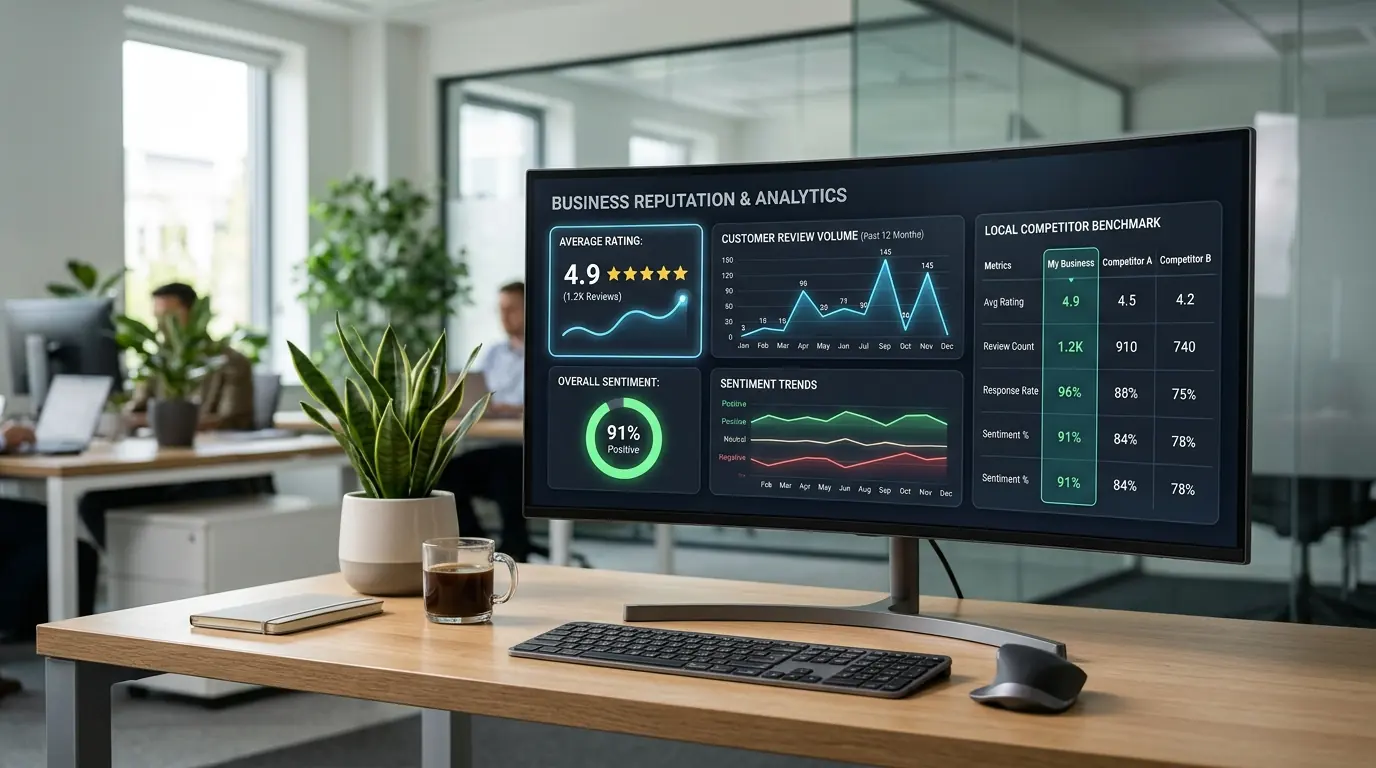
The local benchmark rule: Ignore national averages
One of the most common questions small business owners ask is: “How many Google reviews do I need before I start showing up on the map?”
The answer is always relative to your immediate geographical market. There is no universal threshold. If you run a commercial locksmith business in central London, the top three ranking firms might have 400 to 800 reviews each. But if you run a tree surgery service in Hereford, the top ranking firm might only have 38 reviews, while the second has 22 and the third has 14.
To find your target number, do a simple benchmark search. Search for your main keyword in your town (e.g. “plumber in Harrogate”) and look at the three businesses in the Google Local 3-Pack. Average their review counts. Your short-term goal is to match the lowest number in that pack; your long-term goal is to beat the average by 20%.
A business with 30 fresh reviews collected in the last 90 days will routinely outrank a competitor with 200 reviews who hasn't collected a new one in two years. Google prioritizes active, operating businesses over dormant ones.
The 4 metrics Google’s algorithm actually evaluates
Many business owners mistakenly believe that review count is the only thing Google cares about. In reality, Google’s local ranking algorithm weighs four distinct review factors:
- 1. Review Quantity (Volume): Total number of reviews on your verified profile.
- 2. Star Rating (Quality): Your average rating. A rating between 4.7 and 4.9 is actually proven to convert better than a 5.0, because consumers perceive a flawless 5.0 as suspicious or curated.
- 3. Review Recency & Velocity: How recently your latest reviews were posted, and how consistently new reviews arrive week over week.
- 4. Review Detail (Sentiment & Keywords): Whether the reviewer wrote descriptive sentences naming specific services, team members, and locations, or simply clicked 5 stars with no text.
Why 25 fresh reviews beat 150 old reviews
Imagine two competing roofing companies in Guildford:
- Company A: Has 140 reviews. But their last review was posted 18 months ago, and they haven't received a single new review since.
- Company B: Has 35 reviews. But they received 3 reviews last week, 2 reviews the week before, and 4 reviews earlier this month.
Google’s algorithm strongly favors Company B. Why? Because search engines want to protect their users. An active stream of fresh reviews proves to Google that the company is currently operating, active, reliable, and satisfying customers today. Company A might have changed owners, lost its best roofers, or ceased trading altogether.
How to ask customers for reviews without feeling pushy
The single biggest reason small businesses don’t have enough reviews isn’t that customers are unhappy—it’s that the business owner never asks. Most happy customers are delighted to leave a review, but they will never think to do it on their own.
Timing is everything. Ask at the peak moment of customer delight—right when you have handed over the keys, packed up your tools, or shown them the finished result. Use a conversational script:
“John, I’m so glad you’re pleased with the new bathroom. As a local independent firm, 90% of our work comes from people reading reviews on Google. Would you mind if I texted you our direct review link? It takes about 45 seconds and helps us tremendously.”
When the customer says yes in person, they have made a micro-commitment. When your text arrives 10 minutes later with a direct link, their completion rate skyrockets.
Why direct review links triple your completion rate
Never tell a customer: “Go to Google, search for our business name, click on our profile, find the review button, and leave a review.” Every extra step loses 50% of people.
Send them a direct Google Review URL. When they tap this link on their phone, it instantly opens the Google Maps app with the 5-star rating box already popped up and the keyboard ready to type. Use our free review link generator tool to create your direct review link in 10 seconds.
Building a sustainable habit of 2 to 4 reviews a week
You don't need a massive one-time review blast (which can actually trigger Google's spam filters if 40 reviews appear in 24 hours). You need an ongoing habit:
- Send a polite review request text within 2 hours of finishing every successful job.
- Send one gentle follow-up 48 hours later if they haven’t had a chance to complete it: “Hi Sarah, just wanted to make sure you received the review link I sent earlier. No pressure at all, but we’d love your feedback when you have a moment!”
- Reply to every review you receive within 24 hours to show gratitude.
Following this simple routine will net you 8 to 15 fresh, glowing reviews every single month. Within six months, you will dominate your local map pack.
Frequently asked questions
Can I offer a discount or prize draw for Google reviews?
No! Google's terms of service strictly prohibit review gating, financial incentives, discounts, or raffle entries in exchange for reviews. Doing so can cause Google to delete all your reviews or permanently ban your business listing.
What should I do if a competitor has 300 reviews and I only have 20?
Don't panic. Focus on review recency and review velocity. If you gather 3 detailed, keyword-rich reviews every week while your competitor gets zero, Google's algorithm will begin favoring your active profile for local queries within a few months.
Do reviews from friends and family help?
While friends and family mean well, Google tracks IP addresses, location data, and email accounts. If multiple reviews originate from people who share your Wi-Fi network or have never had real customer interactions, Google will often filter them out automatically.
Should I reply to 5-star reviews as well as bad reviews?
Yes, absolutely! Replying to positive reviews shows appreciation, builds customer loyalty, and gives you an opportunity to naturally mention the service and town in your reply: 'Thanks for trusting us with your kitchen rewiring in Guildford, Mike!'



Not sure where to start?
Run a free check and get your top three fixes in plain words.
Free. No signup. No card.